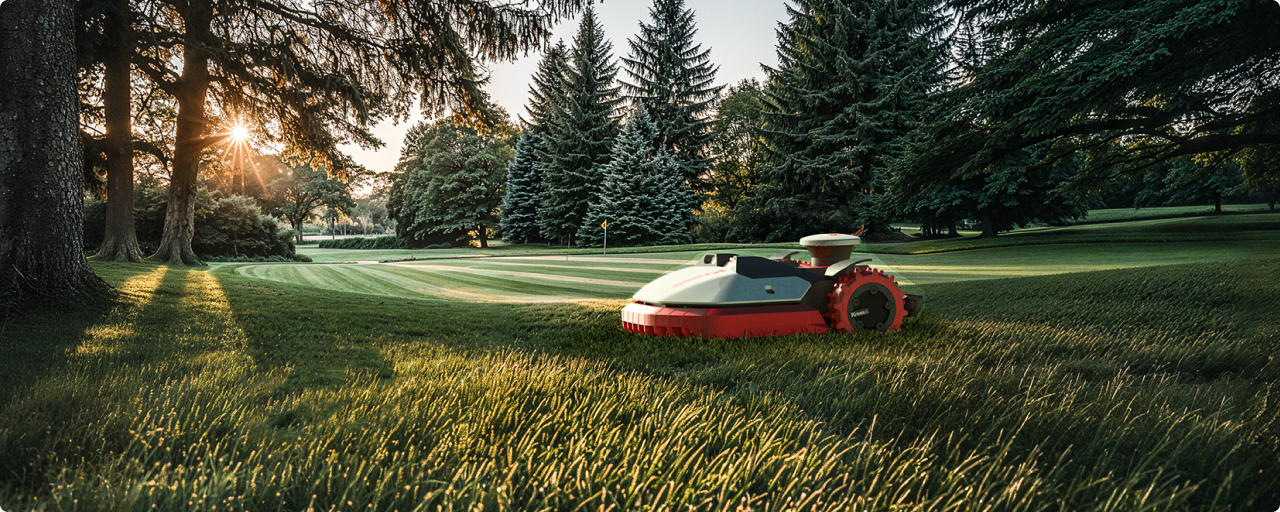


The difference between RTK and RTKn is where the correction signal comes from. RTK robot mowers use satellite positioning plus a local reference station or antenna installed on the property. Kress RTKn uses a network-based correction system, so the mower can achieve high-accuracy, wire-free navigation without a boundary wire, beacons, or a property-mounted antenna.
RTKn is the better fit when the property has open sky, multiple mowing zones, and a need for simple installation. Traditional RTK may still make sense in special cases where a dedicated local base station is preferred or required.
If you’re shopping for a robot mower no boundary wire system, you’ve probably seen both terms: RTK and RTKn. They sound almost identical, and both are used to describe high-accuracy robotic mowing. But in the field, the difference matters.
At Green Industries, we work with homeowners, estate managers, municipal and commercial property crews, golf facilities, and landscape contractors who want to know, “Will this mower work on this property without creating more problems for my crew?”
That is where understanding RTK vs. RTKn helps. Read on to learn more about these mowing technologies and how to choose the right one for your needs.
RTKn vs. RTK in Plain English
In a robotic lawn mower, RTK stands for Real-Time Kinematic positioning. It’s a high-accuracy GPS correction method that helps a robotic mower know where it is within a very tight margin. Instead of wandering randomly or relying on a buried perimeter wire, an RTK mower uses satellite positioning and correction data to follow mapped mowing zones.
Kress RTKn is a network-based version of that idea (the “n” refers to the network). Instead of installing a dedicated reference antenna at the property, the robot mowers connect to a correction network that allows compatible Kress mowers to operate with precise, wire-free navigation and no on-site antenna installation.
Take a look at this table for the practical differences:
| Comparison Point | Traditional RTK | Kress RTKn |
| Boundary wire | Not required | Not required |
| Property antenna | Usually required | Not required |
| Best for | Properties where a local base station makes sense | Residential, commercial, golf, and managed properties within RTKn coverage |
| Installation complexity | Higher | Lower |
| Multi-zone mowing | Good when mapped properly | Excellent for mapped lawns, commercial zones, and larger properties |
| Buyer fit | Specialized setups | Most Green Industries robotic mower customers |
Why This Matters When Buying a Robot Lawn Mower With No Boundary Wire
A robot lawn mower no boundary wire system sounds simple: no trenching, no broken wire, no service calls to find a cut perimeter loop. But “no wire” doesn’t automatically mean “easy.”
Some wire-free robotic mowers still need extra hardware installed around the property. Others need a base station mounted with a clear view of the sky. Some systems may also struggle when the property has buildings, tree cover, tight passages, or disconnected mowing areas.
That is why Green Industries doesn’t recommend robotic mowers based on specs alone. Instead, we look at how the property is actually used.
A quarter-acre residential lawn in Annapolis is a very different installation than a three-acre estate, a commercial entrance, a golf tee complex, or a landscape contractor’s managed account. RTK and RTKn can both deliver precision, but RTKn removes one of the most common friction points: installing and maintaining a dedicated on-site reference antenna.
When RTKn Is the Better Robotic Mower Choice
For most buyers considering a Kress robot mower, RTKn is the more practical choice. It’s especially strong when the property has enough sky visibility, clearly defined mowing areas, and a need for reliable daily maintenance without buried wire.
Here’s an in-depth look at some cases where RTKn is typically the clear winner over RTK:
1. Residential Properties That Want a Clean Installation
Many homeowners want robotic mowing because they’re tired of weekly mowing, noise, fuel, and inconsistent turf appearance. They don’t want a boundary wire that’s at risk of being cut during edging, aeration, mulch work, or landscape bed expansion.
For these customers, RTKn is usually the cleaner solution. The lawn is mapped virtually, the mower follows planned routes, and there is no perimeter wire to repair later.
Choose RTKn for:
- Suburban lawns up to the mower’s rated capacity
- Open front and back yards
- Homes with defined turf areas and landscape beds
- Properties where the owner wants daily mowing and a consistently maintained look
For most residential customers, start with RTKn unless the property has a dense tree canopy, unusual signal blockage, or areas where coverage needs to be confirmed first.
2. Larger Homes and Estate Properties With Multiple Zones
Estate properties are where RTKn starts to separate itself from simpler robotic mowing options. These lawns often include front turf, rear turf, side yards, pool areas, long driveways, and separate mowing zones.
In estate environments, a traditional wire system can become complicated quickly. A standard RTK system may solve the wire issue, but it still requires careful antenna placement. RTKn simplifies the hardware side while still allowing precise zone mapping.
RTKn shines for:
- High-end residential properties
- Multi-zone lawns
- Large open turf areas
- Properties where appearance matters every day
- Owners who want less crew disruption around the home
RTKn is often the right fit for estates where the mower needs to move from one turf area to another and maintain a clean, professional cut without visible infrastructure.
3. Commercial Properties and Business Campuses
For commercial properties, the labor conversation matters as much as the mowing technology. Property managers and maintenance crews want consistency, lower noise, reduced fuel use, and fewer routine mowing hours.
RTKn can be a strong option for:
- Office lawns
- Retail centers
- HOA common areas
- Municipal turf
- Apartment and condominium grounds
- Managed commercial accounts
A Kress RTKn mower can maintain turf quietly and frequently, which helps avoid the “overgrown by Friday” look that comes from weekly mowing schedules. It also allows crews to redirect labor toward trimming, edging, pruning, cleanup, irrigation checks, and detail work.
RTKn is usually the better choice for commercial properties with open turf, recurring maintenance needs, and a clear business case for reducing repetitive mowing labor.
4. Golf Courses and Fine Turf Areas
Golf properties are one of the strongest use cases for Kress RTKn. Golf turf is more than grass; it’s a playing surface where consistency, quiet operation, and reduced disruption matter.
RTKn is especially useful around:
- Driving range areas
- Tee complexes
- Clubhouse turf
- Practice areas
- Roughs and maintained perimeter turf
- Open fairway-style areas suited to robotic mowing
A robotic mower with no boundary wire setup is valuable on golf properties because buried wires and extra hardware can interfere with maintenance routines, aeration, renovations, and day-to-day turf work. RTKn gives superintendents and turf managers a way to automate mowing without adding unnecessary obstacles to the property.
For golf and managed turf, RTKn is typically the preferred direction because it supports precision, repeatability, and reduced disruption across complex turf environments.
When Traditional RTK May Still Make Sense
So far, we’ve highlighted the many benefits of RKTn. But RTKn is not automatically the answer for every property. Traditional RTK can still be useful when a dedicated local reference station is the best way to support the site.
Cases where this may apply:
- The property is outside RTKn coverage
- Cellular connection is unreliable
- The site requires a dedicated correction source
- The property has unusual technical requirements
- The buyer already has infrastructure suited to local RTK
In those cases, traditional RTK may offer more control over the correction setup. The tradeoff is added installation complexity. Someone has to place the antenna correctly, make sure it has the right sky view, and account for how buildings, trees, and terrain may affect the system.
Therefore, we recommend you consider traditional RTK only when the site conditions call for it. For most buyers comparing robotic mower systems today, RTKn is the easier and more scalable choice.
Property Size: Which System Fits Best?
Property size is one of the first filters we use when helping customers choose a robotic mower.
Small Residential Lawns
Best choice: RTKn, assuming coverage and layout check out.
For smaller residential lawns, RTKn is usually attractive because it avoids the hassle of wire installation. A simple half-acre lawn with open sky can be easier for a robot mower than a smaller lawn broken into narrow strips, fenced pockets, and tree-covered corridors.
Mid-Size Residential and Estate Lawns
Best choice: RTKn.
This is where Kress RTKn often becomes the strongest recommendation. These properties are large enough to benefit from automation but still need a clean, low-disruption installation. Multi-zone mapping is important, and the lack of boundary wire is a major advantage.
Large Commercial or Institutional Properties
Best choice: RTKn for most sites; evaluate traditional RTK only when network or signal conditions require it.
Commercial properties need a system that can be planned around labor savings, mowing schedules, and maintenance priorities. RTKn is usually the better fit when the property has open turf and repeatable mowing zones.
Golf and Specialty Turf
Best choice: RTKn, with a professional site review.
Golf properties need predictable operation, quiet performance, and careful zone planning. RTKn is well-suited to many of these applications, especially when the mowing area has open sky and a clear operational plan.
Terrain Complexity: What We Look For Before Recommending a System
Terrain matters as much as acreage because a robotic mower doesn’t see a property the way a person does. To recommend the right system, our team looks at the turf, obstacles, signal environment, and how the mower will travel.
Important site factors include:
- Tree canopy
- Buildings near the mowing area
- Narrow passages
- Fenced sections
- Retaining walls
- Slopes
- Drainage areas
- Mulch beds and hardscape edges
- Separated mowing zones
- Areas where people, pets, carts, or vehicles frequently move
A wide-open two-acre property may be a great RTKn candidate. A heavily wooded half-acre property with tight side yards and poor sky visibility may need more careful evaluation.
That’s why Green Industries recommends matching the mower to the property instead of buying based only on acreage.
RTK vs. RTKn: Which One Do You Need?
Need a quick reference to help you decide?
Choose Kress RTKn if you want:
- A robot mower with no boundary wire
- No antenna installed on your property
- A cleaner installation
- Multi-zone mowing
- Daily, consistent turf maintenance
- A strong fit for residential, estate, commercial, or golf applications
Consider traditional RTK if:
- RTKn coverage isn’t available at your site
- You need a dedicated local reference station
- Your property has special technical requirements
- A professional site review shows RTKn isn’t the best fit
For most Green Industries customers, RTKn is the right starting point.
Frequently Asked Questions
What does RTK mean in a lawn mower?
RTK stands for Real-Time Kinematic positioning, a GPS correction method that narrows a robotic mower’s location to within a few centimeters. That accuracy is what lets the mower stay inside its mapped mowing zones without a buried boundary wire.
What is Kress RTKn, and how is it different from RTK?
Kress RTKn is the network-based version of RTK. Traditional RTK usually needs a dedicated reference antenna installed at the property. RTKn skips that step entirely, connecting to Kress’ correction network instead, so there’s less hardware to install and maintain.
How do I know if my property has RTKn coverage?
Coverage depends on where your property sits relative to Kress’s RTKn network. Green Industries checks this for your address before you buy, so you’re not guessing whether RTKn will work at your site.
Why does RTK accuracy matter for a robot mower?
Without high-accuracy positioning, a mower can drift outside its mapped lines, missing spots or crossing into beds and walkways. RTK’s correction data is what keeps it on track. Fast convergence, how quickly the system locks onto a stable position after startup, determines how soon that accuracy kicks in.
Is Kress RTKn or traditional RTK the better choice for my property?
For most properties, Kress RTKn is the better starting point. Traditional RTK still makes sense if RTKn coverage isn’t available at your site or the property has technical requirements a local base station handles better.
Ready to Compare Kress Robot Mowers?
If you need help selecting a robot mower in Annapolis, MD, contact Green Industries.
We’re Annapolis’ go-to power equipment dealership for lawn care professionals seeking an unparalleled equipment selection and customer service that puts your needs at the forefront of your shopping experience.
Our team can help you compare Kress RTKn models, evaluate your property, and choose the right robotic mowing setup for your home, business, managed property, or golf facility.