
Green Industries Experience Year 2 is Here! Click here to learn more!

How Does a Robot Lawn Mower Work Without a Boundary Wire?

A robotic mower knows where to mow by using a guidance system that tells it where the lawn begins, where it ends, and which areas to avoid. 

In plain language, the mower isn’t “guessing.” It’s following either a physical signal in the ground or a digital map created during setup. 

For commercial buyers managing large lawns, campuses, sports fields, golf course areas, estates, municipal grounds, or multi-zone properties, that difference matters. A perimeter wire system depends on a cable around the property. An RTK robotic mower uses high-precision positioning to understand where it is and where it needs to go.

Keep reading to learn more about how robotic lawn mowers navigate a property.

How Does a Robotic Mower Work?

“How does a robotic mower work?” comes down to two main questions: how does it cut the grass, and how does it know where to go?

How a Robotic Mower Cuts the Grass

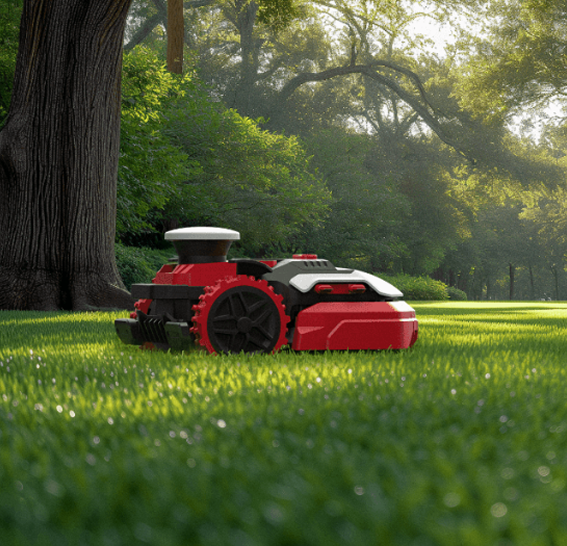
The cutting part is fairly simple. A robotic mower uses battery power, onboard motors, and cutting blades to trim grass automatically. 

Instead of letting the lawn grow tall and then cutting off a large amount at once, most robotic mowers maintain the turf by cutting frequently. The clippings are fine enough to fall back into the lawn, where they can help return nutrients to the soil.

How a Robotic Mower Knows Where to Mow

The navigation part is where the technology has changed dramatically over the years.

A robotic mower needs to understand:

  • The outer boundary of the mowing area
  • No-mow zones such as mulch beds, water features, parking lots, flower beds, and steep drop-offs
  • Paths between mowing zones
  • Docking station location
  • Obstacles like trees, benches, signs, fences, cart paths, and buildings
  • Slope, terrain changes, and areas where traction may vary

For years, the solution was a boundary wire. Today, RTK GPS has created a more flexible option, especially for larger and more complex commercial properties.

Perimeter Wire Systems: The Traditional Way

A perimeter wire system uses a low-voltage wire placed around the mowing area. That wire sends a signal that the mower can detect. When the mower approaches the wire, it knows it has reached the edge of the approved mowing zone and turns away.

For a small, simple residential lawn, this can work well. If the property is a rectangle with a few beds and a clear edge, the installation may be manageable.

Now picture a larger property, such as a private estate, school campus, or golf course. These properties have varied terrain, trees, multiple buildings, and numerous obstacles.

With a wire-based system, each boundary and exclusion zone has to be planned and installed. If the property layout changes, the wire may need to be moved. If a utility project or animal damage breaks the wire, the mower may stop working until the issue is found and repaired.

That’s why many commercial buyers are now asking about a robot lawn mower with no boundary wire.

RTK GPS: The Wire-Free Way

RTK stands for Real-Time Kinematic. It’s a high-accuracy positioning technology that improves standard satellite navigation.

Standard GPS, like what you use in a car or phone, is usually accurate enough to get you to a parking lot, a building, or a street address. However, this isn’t precise enough for mowing. A commercial robotic mower needs to know whether it’s on the fairway edge, in the rough, near a sidewalk, or about to cross into a landscape bed.

RTK improves the location accuracy by correcting satellite positioning in real time. Instead of giving the mower a rough location, RTK helps the mower understand its position with much tighter precision. That’s what allows a Kress RTK robotic mower to follow a mapped mowing area without relying on a buried boundary wire.

Think of it this way: A perimeter wire is like a physical fence the mower can sense.

RTK is like giving the mower a highly accurate digital map and the ability to locate itself on that map while it works.

Does a Robotic Mower Need Boundary Wire?

Not always. Some robotic mowers still need boundary wire; many traditional models rely on it completely. But newer RTK robotic mowers can operate without perimeter wire when the property is properly mapped and the mower has the satellite visibility and setup conditions it needs.

With RTK, the dealer maps the property, defines the mowing zones, sets no-go areas, and configures the mower’s routes and schedules—no wires required.

How Accurate Is RTK GPS on a Robotic Mower?

RTK GPS is commonly described as centimeter-level positioning. In the real world, that means the mower can follow digital mowing boundaries with a high degree of precision when the property is properly set up, and the mower maintains a reliable positioning signal.

For commercial mowing, that accuracy is crucial. A difference of several feet may not matter when navigating a vehicle on a road, but it matters immensely when a mower is working near a cart path, pond edge, sports field line, or newly planted area.

That said, RTK isn’t magic, and site conditions still matter.

During Kress RTK evaluations and installations, the Green Industries team pays close attention to:

  • Tree cover that may interfere with satellite visibility
  • Buildings that can block or reflect signals
  • Narrow corridors between structures
  • Rolling terrain and slope transitions
  • Wet areas that may affect traction
  • Docking station placement
  • Mower access between separate turf zones
  • High-traffic areas where people or vehicles may cross the mowing path

These observations are a major reason to work with an experienced dealer rather than treating a commercial robotic mower like a simple out-of-the-box gadget. The mower is autonomous, but the setup should be intentional.

Perimeter Wire vs. RTK: A Large Property Example

Imagine a five-acre commercial property that consists of:

  • A main building, 
  • A long entrance drive
  • Landscape beds
  • Several tree islands
  • A stormwater area
  • Turf on both sides of a parking lot

With a perimeter wire mower, the installation may require wire around the outer property boundary, around every no-mow island, along pavement transitions, and possibly through narrow connection points between zones. If the grounds team later expands a bed, repairs irrigation, or changes the turf layout, the wire may need attention.

With an RTK robotic mower, the mowing boundary is created digitally. No-mow zones are mapped into the system. The mower uses high-accuracy satellite positioning to understand where it is on the property. If the mowing plan needs to change, the digital map can be updated without trenching or reworking a physical boundary loop.

In sum, wire-based systems define the lawn with cable. RTK systems define the lawn with data.

What Happens Around Trees, Slopes, and Obstacles?

This is one of the first questions robot mower buyers ask, and rightfully so.

Commercial properties are rarely perfect rectangles. They have slopes, low spots, shade, drainage areas, tree canopies, traffic patterns, and objects that move. A good robotic mower setup has to account for all of that.

In real-world Kress RTK setups, these details are part of the site conversation. Where should the charging station go? Does the mower have a clear path to each zone? Are there areas that should be excluded after heavy rain? Is a section too narrow, too shaded, too steep, or too interrupted for reliable autonomous mowing?

The best installations match the mower, the map, the schedule, and the property conditions to create a highly accurate, labor-saving mower system.

Is a Robot Lawn Mower With No Boundary Wire Right for Every Property?

No. A wire-free RTK mower is powerful technology, but that doesn’t mean it’s right for every property. A good candidate typically has meaningful acreage, repeat mowing needs, manageable terrain, and areas where autonomous mowing can operate safely and efficiently. 

Strong fits include:

  • Wide-open turf
  • Large lawns
  • Golf practice areas
  • Sports field surroundings
  • Commercial frontage
  • Estate grounds

A more challenging site is one with:

  • Dense tree cover
  • Many disconnected micro-zones
  • Heavy pedestrian activity
  • Narrow strips of turf
  • Steep slopes
  • Poor access to a practical docking location

These conditions don’t automatically rule out robotic mowing, but the setup needs a closer look before installation. In some cases, one area of a property may be ideal for RTK robotic mowing while another area is better handled by a traditional crew.

The Bottom Line: How Does a Robot Lawn Mower Know Where to Mow?

A robotic mower knows where to mow by following a defined mowing boundary. Traditional models use perimeter wire. Advanced models with RTK use satellite-guided positioning and a digital property map.

For commercial buyers, RTK is the technology that makes robotic mowing more practical on larger and more complex properties. Instead of installing and maintaining long runs of boundary wire, the mower can operate from mapped zones with high-accuracy positioning.

If you’re considering a Kress RTK robotic mower, the most important step is a site evaluation. Green Industries can help determine whether your property is a good fit, identify terrain or signal challenges, and recommend the right robotic mowing setup for your acreage, layout, and maintenance goals.

Ready to See How RTK Robotic Mowing Could Work on Your Property?

Green Industries works with commercial mowing equipment every day, including Kress RTK robotic mower technology for large-property applications. 

The best way to understand how robot lawn mowers work is to see it for yourself. A demo can show you how the mower maps, navigates, docks, avoids no-mow zones, and fits into your existing grounds maintenance plan.

To learn more, contact Green Industries to schedule a Kress RTK robotic mower consultation or demo.
RTK vs. RTKn: What’s the Difference and Which Do You Need?

The difference between RTK and RTKn is where the correction signal comes from. RTK robot mowers use satellite positioning plus a local reference station or antenna installed on the property. Kress RTKn uses a network-based correction system, so the mower can achieve high-accuracy, wire-free navigation without a boundary wire, beacons, or a property-mounted antenna. 

RTKn is the better fit when the property has open sky, multiple mowing zones, and a need for simple installation. Traditional RTK may still make sense in special cases where a dedicated local base station is preferred or required.

If you’re shopping for a robot mower no boundary wire system, you’ve probably seen both terms: RTK and RTKn. They sound almost identical, and both are used to describe high-accuracy robotic mowing. But in the field, the difference matters.

At Green Industries, we work with homeowners, estate managers, municipal and commercial property crews, golf facilities, and landscape contractors who want to know, “Will this mower work on this property without creating more problems for my crew?”

That is where understanding RTK vs. RTKn helps. Read on to learn more about these mowing technologies and how to choose the right one for your needs.

RTK vs. RTKn in Plain English

RTK stands for Real-Time Kinematic positioning. It’s a high-accuracy GPS correction method that helps a robotic mower know where it is within a very tight margin. Instead of wandering randomly or relying on a buried perimeter wire, an RTK mower uses satellite positioning and correction data to follow mapped mowing zones.

RTKn is Kress’s network-based version of that idea. The “n” refers to the network. Instead of installing a dedicated reference antenna at the property, a Kress robot mower connects to Kress’s correction network. That allows compatible Kress mowers to operate with precise, wire-free navigation and no on-site antenna installation.

Take a look at this table for the practical differences:

Comparison PointTraditional RTKKress RTKn
Boundary wireNot requiredNot required
Property antennaUsually requiredNot required
Best forProperties where a local base station makes senseResidential, commercial, golf, and managed properties within RTKn coverage
Installation complexityHigherLower
Multi-zone mowingGood when mapped properlyExcellent for mapped lawns, commercial zones, and larger properties
Buyer fitSpecialized setupsMost Green Industries robotic mower customers

Why This Matters When Buying a Robot Lawn Mower With No Boundary Wire

A robot lawn mower no boundary wire system sounds simple: no trenching, no broken wire, no service calls to find a cut perimeter loop. But “no wire” doesn’t automatically mean “easy.”

Some wire-free robotic mowers still need extra hardware installed around the property. Others need a base station mounted with a clear view of the sky. Some systems may also struggle when the property has buildings, tree cover, tight passages, or disconnected mowing areas.

That is why Green Industries doesn’t recommend robotic mowers based on specs alone. Instead, we look at how the property is actually used.

A quarter-acre residential lawn in Annapolis is a very different installation than a three-acre estate, a commercial entrance, a golf tee complex, or a landscape contractor’s managed account. RTK and RTKn can both deliver precision, but RTKn removes one of the most common friction points: installing and maintaining a dedicated on-site reference antenna.

When RTKn Is the Better Robotic Mower Choice

For most buyers considering a Kress robot mower, RTKn is the more practical choice. It’s especially strong when the property has enough sky visibility, clearly defined mowing areas, and a need for reliable daily maintenance without buried wire.

Here’s an in-depth look at some cases where RTKn is typically the clear winner over RTK:

1. Residential Properties That Want a Clean Installation

Many homeowners want robotic mowing because they’re tired of weekly mowing, noise, fuel, and inconsistent turf appearance. They don’t want a boundary wire that’s at risk of being cut during edging, aeration, mulch work, or landscape bed expansion.

For these customers, RTKn is usually the cleaner solution. The lawn is mapped virtually, the mower follows planned routes, and there is no perimeter wire to repair later.

Choose RTKn for:

  • Suburban lawns up to the mower’s rated capacity
  • Open front and back yards
  • Homes with defined turf areas and landscape beds
  • Properties where the owner wants daily mowing and a consistently maintained look

For most residential customers, start with RTKn unless the property has a dense tree canopy, unusual signal blockage, or areas where coverage needs to be confirmed first.

2. Larger Homes and Estate Properties With Multiple Zones

Estate properties are where RTKn starts to separate itself from simpler robotic mowing options. These lawns often include front turf, rear turf, side yards, pool areas, long driveways, and separate mowing zones.

In estate environments, a traditional wire system can become complicated quickly. A standard RTK system may solve the wire issue, but it still requires careful antenna placement. RTKn simplifies the hardware side while still allowing precise zone mapping.

RTKn shines for:

  • High-end residential properties
  • Multi-zone lawns
  • Large open turf areas
  • Properties where appearance matters every day
  • Owners who want less crew disruption around the home

RTKn is often the right fit for estates where the mower needs to move from one turf area to another and maintain a clean, professional cut without visible infrastructure.

3. Commercial Properties and Business Campuses

For commercial properties, the labor conversation matters as much as the mowing technology. Property managers and maintenance crews want consistency, lower noise, reduced fuel use, and fewer routine mowing hours.

RTKn can be a strong option for:

  • Office lawns
  • Retail centers
  • HOA common areas
  • Municipal turf
  • Apartment and condominium grounds
  • Managed commercial accounts

A Kress RTKn mower can maintain turf quietly and frequently, which helps avoid the “overgrown by Friday” look that comes from weekly mowing schedules. It also allows crews to redirect labor toward trimming, edging, pruning, cleanup, irrigation checks, and detail work.

RTKn is usually the better choice for commercial properties with open turf, recurring maintenance needs, and a clear business case for reducing repetitive mowing labor.

4. Golf Courses and Fine Turf Areas

Golf properties are one of the strongest use cases for Kress RTKn. Golf turf is more than grass; it’s a playing surface where consistency, quiet operation, and reduced disruption matter.

RTKn is especially useful around:

  • Driving range areas
  • Tee complexes
  • Clubhouse turf
  • Practice areas
  • Roughs and maintained perimeter turf
  • Open fairway-style areas suited to robotic mowing

A robotic mower with no boundary wire setup is valuable on golf properties because buried wires and extra hardware can interfere with maintenance routines, aeration, renovations, and day-to-day turf work. RTKn gives superintendents and turf managers a way to automate mowing without adding unnecessary obstacles to the property.

For golf and managed turf, RTKn is typically the preferred direction because it supports precision, repeatability, and reduced disruption across complex turf environments.

When Traditional RTK May Still Make Sense

So far, we’ve highlighted the many benefits of RKTn. But RTKn is not automatically the answer for every property. Traditional RTK can still be useful when a dedicated local reference station is the best way to support the site.

Cases where this may apply:

  • The property is outside RTKn coverage
  • Cellular connection is unreliable
  • The site requires a dedicated correction source
  • The property has unusual technical requirements
  • The buyer already has infrastructure suited to local RTK

In those cases, traditional RTK may offer more control over the correction setup. The tradeoff is added installation complexity. Someone has to place the antenna correctly, make sure it has the right sky view, and account for how buildings, trees, and terrain may affect the system.

Therefore, we recommend you consider traditional RTK only when the site conditions call for it. For most buyers comparing robotic mower systems today, RTKn is the easier and more scalable choice.

Property Size: Which System Fits Best?

Property size is one of the first filters we use when helping customers choose a robotic mower.

Small Residential Lawns

Best choice: RTKn, assuming coverage and layout check out.

For smaller residential lawns, RTKn is usually attractive because it avoids the hassle of wire installation. A simple half-acre lawn with open sky can be easier for a robot mower than a smaller lawn broken into narrow strips, fenced pockets, and tree-covered corridors.

Mid-Size Residential and Estate Lawns

Best choice: RTKn.

This is where Kress RTKn often becomes the strongest recommendation. These properties are large enough to benefit from automation but still need a clean, low-disruption installation. Multi-zone mapping is important, and the lack of boundary wire is a major advantage.

Large Commercial or Institutional Properties

Best choice: RTKn for most sites; evaluate traditional RTK only when network or signal conditions require it.

Commercial properties need a system that can be planned around labor savings, mowing schedules, and maintenance priorities. RTKn is usually the better fit when the property has open turf and repeatable mowing zones.

Golf and Specialty Turf

Best choice: RTKn, with a professional site review.

Golf properties need predictable operation, quiet performance, and careful zone planning. RTKn is well-suited to many of these applications, especially when the mowing area has open sky and a clear operational plan.

Terrain Complexity: What We Look For Before Recommending a System

Terrain matters as much as acreage because a robotic mower doesn’t see a property the way a person does. To recommend the right system, our team looks at the turf, obstacles, signal environment, and how the mower will travel.

Important site factors include:

  • Tree canopy
  • Buildings near the mowing area
  • Narrow passages
  • Fenced sections
  • Retaining walls
  • Slopes
  • Drainage areas
  • Mulch beds and hardscape edges
  • Separated mowing zones
  • Areas where people, pets, carts, or vehicles frequently move

A wide-open two-acre property may be a great RTKn candidate. A heavily wooded half-acre property with tight side yards and poor sky visibility may need more careful evaluation.

That’s why Green Industries recommends matching the mower to the property instead of buying based only on acreage.

RTK vs. RTKn: Which One Do You Need?

Need a quick reference to help you decide?

Choose Kress RTKn if you want:

  • A robot mower with no boundary wire
  • No antenna installed on your property
  • A cleaner installation
  • Multi-zone mowing
  • Daily, consistent turf maintenance
  • A strong fit for residential, estate, commercial, or golf applications

Consider traditional RTK if:

  • RTKn coverage isn’t available at your site
  • You need a dedicated local reference station
  • Your property has special technical requirements
  • A professional site review shows RTKn isn’t the best fit

For most Green Industries customers, RTKn is the right starting point.

Ready to Compare Kress Robot Mowers?

If you need help selecting a robot mower in Annapolis, MD, contact Green Industries

We’re Annapolis’ go-to power equipment dealership for lawn care professionals seeking an unparalleled equipment selection and customer service that puts your needs at the forefront of your shopping experience. 

Our team can help you compare Kress RTKn models, evaluate your property, and choose the right robotic mowing setup for your home, business, managed property, or golf facility.