Green Industries Experience Year 2 is Here! Click here to learn more!

How Much Does a Commercial Robotic Mower Cost?

A commercial robotic mower typically costs $6,000 to $15,000 for most multi-acre robotic lawn mower systems, while larger commercial fleet-ready units can reach $60,000 or more before installation, accessories, and ongoing service.

That’s the short answer, at least. The longer answer is that the total commercial robotic lawn mower price depends on the amount of turf you need to maintain, the complexity of the property, the mower’s navigation and obstacle avoidance technology, and how much labor the system can realistically replace or redeploy.

Below is a frank breakdown from the perspective of Green Industries as a dealer.

Commercial Robotic Lawn Mower Price Ranges

Here are the general price ranges most commercial buyers should expect for robot mowers:

Type of robotic mowerTypical equipment priceBest use cases
Large residential/light commercial robotic mower$3,000 to $6,000Large homes, small commercial sites, simple turf areas
Multi-acre commercial robotic mower$6,000 to $15,000Campuses, HOAs, sports fields, municipal grounds, golf course areas, commercial properties
Fleet-ready or high-output commercial robotic mower$15,000 to $60,000+Contractors, golf courses, municipalities, and large properties scaling robotic mowing across multiple zones

Most commercial buyers shopping for a serious autonomous mower should plan around $6,000 to $15,000 for the mower itself. Installation, setup, mapping, accessories, and service add further costs.

Kress Robotic Mower Price Examples

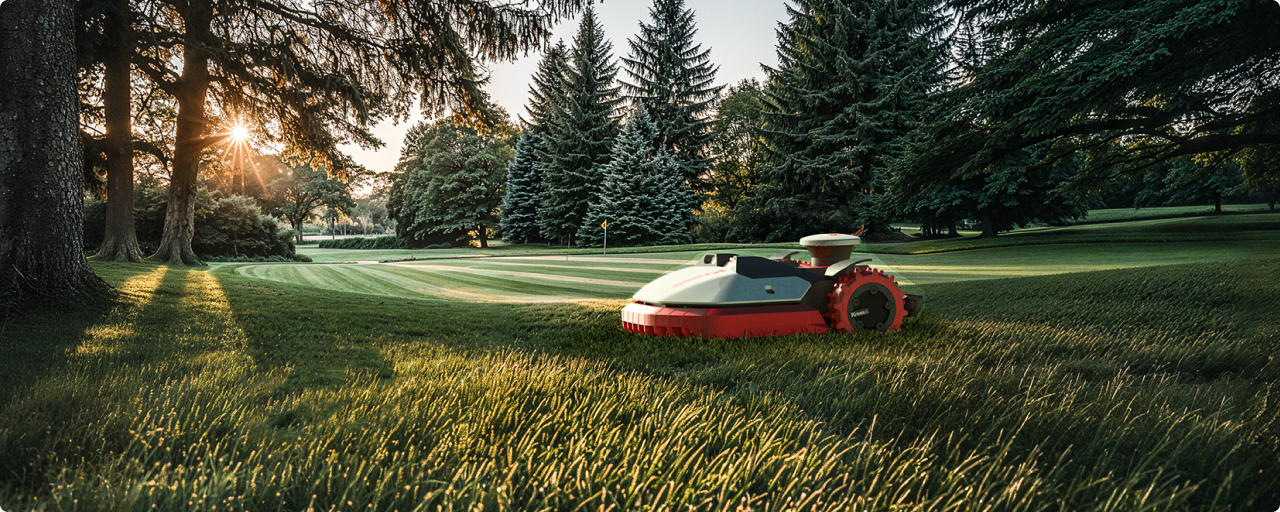
Green Industries carries Kress robotic mowing solutions because they’re built for real-world commercial turf care. Kress RTK robotic mowers use satellite-guided navigation instead of traditional buried boundary wire, which makes them a strong fit for larger or more complex properties.

For a better sense of what price you can expect, here are a few examples:

Kress RTKN KR233 Robotic Mower

The Kress KR233 is a strong entry point for commercial robotic mowing. It has a recommended mowing capacity of 3 acres and a maximum capacity of up to 4.5 acres, depending on mowing frequency and site conditions.

Current pricing for the Kress KR233 averages $8,499.99 for the robot mower itself.

This model is a good fit for commercial properties, larger estates, smaller campuses, and turf areas where a crew currently spends several recurring labor hours each week mowing the same ground.

Kress KR236 RTK Robotic Mower

The Kress KR236 steps up to a larger commercial footprint. It has a recommended mowing capacity of 6 acres and a maximum capacity of up to 9 acres.

The current listed price is around $13,799.99.

For properties with several acres of maintained turf, this is where the ROI of a robotic mower begins to shine. The higher purchase price can be easier to justify when the mower is taking over frequent, repetitive mowing that would otherwise require paid crew time every week.

Larger Commercial Robotic Mower Systems

For larger operations, Kress also offers higher-output commercial robotic mowing options, including models designed for greater acreage, fleet coordination, and contractor-style productivity. 

These systems can reach $60,000 or more for advanced commercial units such as the Kress KR800 Voyager.

That price point is high, without a doubt. But it starts to make sense when you’re evaluating the robotic mower against a full mowing route, multiple labor positions, high fuel use, or a large commercial site that needs consistent mowing without constantly pulling crew members away from higher-value work.

What Drives Robot Lawn Mower Price?

The price of a robotic mower comes down to acreage, terrain, navigation technology, obstacle handling, and the level of support needed to deploy the system correctly. Here’s a closer look:

1. Acreage Coverage

The more ground a robotic mower can maintain, the more it tends to cost.

A mower designed for a half-acre residential yard isn’t built the same way as a commercial robotic mower expected to maintain several acres across multiple zones. Commercial properties need longer runtime, better traction, stronger cutting systems, smarter scheduling, and more durable components.

When comparing robot lawn mower prices, don’t evaluate models by maximum acreage. Use recommended acreage instead.

Recommended acreage (often known as recommended area) is the more practical number because it reflects how the mower performs under a realistic mowing schedule. Maximum acreage usually assumes longer mowing windows and ideal conditions.

2. RTK Navigation vs Boundary Wire

Older robotic mower systems often depended on buried perimeter wire. That wire adds labor installation time upfront. And it can lead to future repair issues if it gets cut during landscaping, aeration, construction, or utility work.

Kress RTK robotic mowers use satellite-guided RTK navigation. That means they can operate without traditional perimeter wire or a property-specific stationary antenna. For commercial properties, this can reduce installation disruption and make it easier to manage large or changing sites.

RTK technology adds value because it gives the mower the precision needed to mow in professional, organized patterns instead of wandering randomly.

3. OAS (Obstacle Avoidance System)

OAS, or Obstacle Avoidance System, is another factor that affects commercial robotic lawn mower prices.

On a commercial property, the mower encounters trees, signs, benches, curbs, landscaping features, people, animals, maintenance equipment, and temporary objects. Better obstacle detection helps the mower operate more reliably with fewer interruptions.

For many commercial buyers, OAS is a key part of making autonomous mowing practical in a real operating environment.

4. Installation, Mapping, and Setup

Installation is one of the most overlooked parts of the total cost.

Even with wire-free RTK robotic mowers, a commercial robotic mower still needs proper setup. A dealer typically helps with:

  • Site evaluation
  • Mower selection
  • Zone planning
  • Mapping
  • Docking station placement
  • Charging setup
  • App configuration
  • Schedule setup
  • Testing and adjustments
  • Operator training

For many commercial robotic mower installations, setup may add $500 to $3,000+. The final cost depends on property size, complexity, number of zones, mower quantity, and how much dealer support you require.

A simple, open property with one large turf area is easier to deploy than a campus with narrow corridors, tree cover, multiple mowing zones, sidewalks, athletic fields, and restricted operating hours. Either way, it’s key to budget for setup before you make a purchase decision.

5. Accessories and Site Requirements

The mower itself is only part of the system. Depending on the property, you may also need:

  • Charging station equipment
  • Replacement blades
  • Extra batteries or power accessories
  • Connectivity setup
  • Mounting or protection for charging areas
  • Additional units for multi-zone properties
  • Fleet management support
  • Seasonal storage or maintenance service

These items are usually not the biggest part of the budget, but you should still include them when comparing robotic mowing equipment to traditional mowers.

6. Ongoing Service and Maintenance

Robotic mowers reduce many traditional mowing costs, but they aren’t maintenance-free.

Ongoing service may include:

  • Blade replacement
  • Cleaning
  • Software and firmware updates
  • Battery health checks
  • Wheel and drive system inspection
  • Charging station inspection
  • Sensor checks
  • Seasonal startup and winterization
  • Troubleshooting and remapping if the property changes

Compared with gas-powered mowing equipment, robotic mowers eliminate many fuel and engine-related maintenance costs. There are no oil changes, spark plugs, belts, filters, or engine service in the same way a gas mower requires. 

However, commercial users should still budget for routine service to keep the system performing properly and get the most value out of it long-term.

How to Think About Robot Mower ROI Versus Traditional Mowing Labor

The real long-term value of a commercial robotic mower is the labor it saves.

Here is a simple way to think about ROI:

Weekly mowing hours saved × hourly labor cost × mowing weeks per year = annual labor value

For example, if a property takes 8 labor hours per week to mow and labor costs $25 per hour, that comes to:

8 hours × $25 × 32 mowing weeks = $6,400 per year

In this example, a mower in the $6,000 to $15,000 range may start to look very different. If the robotic mower can take over most of those repetitive mowing hours, the payback window may be measured in seasons, not decades.

And that calculation doesn’t include fuel savings, reduced wear on traditional equipment, lower noise, more consistent turf appearance, or the ability to move crew members to higher-value work like trimming, edging, pruning, irrigation checks, bed maintenance, enhancements, and customer service.

Robotic Mowers Do Not Replace Every Crew Task

While a commercial mower can offer valuable savings, it’s not a complete landscaping crew in a box.

You may still need people for:

  • Trimming
  • Edging
  • Blowing
  • Detail work
  • Cleanup
  • Steep or highly irregular areas
  • Storm debris
  • Seasonal turf repairs
  • Landscape maintenance outside mowing

The best use case is to let robotic mowers handle the repetitive acreage mowing while your crew takes care of the skilled finish work. With this combination, robotic mowing can improve margins without reducing service quality.

When a Commercial Robotic Mower Makes Financial Sense

A commercial robotic mower is usually worth a serious look when:

  • The same turf is being mowed every week
  • Labor is hard to hire or retain
  • Crews are stretched thin during peak season
  • Fuel and maintenance costs keep rising
  • Noise reduction matters
  • The site has several acres of maintained turf
  • Crew time could be better used on higher-value tasks
  • The property owner wants cleaner, quieter, lower-emission equipment

It may not be the best fit if the turf area is very small, constantly changing, heavily obstructed, or doesn’t require frequent mowing.

Dealer Support Matters

Buying a commercial robotic mower is different from buying a push mower or even a zero-turn mower:

  • The mower needs to be matched to the site. 
  • The mowing zones need to be planned. 
  • The system needs to be installed, mapped, tested, and adjusted. 
  • Someone needs to know how to service the mower when something changes.

These considerations are why working with a dealer matters.

Green Industries helps commercial buyers evaluate property size, mowing frequency, terrain, mower capacity, installation needs, and long-term service expectations before recommending a system.

A review site can estimate a robot lawn mower price, but a dealer can help you understand what the system will actually cost to install, operate, and maintain on your property.

Bottom Line: How Much Does a Robot Lawn Mower Cost?

For commercial use, most robotic mower buyers should expect to spend $6,000 to $15,000 for a capable multi-acre mower, plus $500 to $3,000+ for installation and setup. Larger fleet-ready robotic mowing systems can cost $15,000 to $60,000+, depending on output, acreage, and application.

When evaluating pricing and ROI, ask:

  • How many labor hours can it save each week?
  • How many acres can it maintain reliably?
  • Does it have RTK navigation?
  • Does it include obstacle avoidance?
  • What installation support is included?
  • What ongoing service will it need?
  • How quickly can it pay back through labor savings?

For many commercial properties, robotic mowing is a labor strategy instead of just another equipment purchase.

Ready to Price a Commercial Robotic Mower?

Getting excited about robotic mowers? Green Industries can help you compare Kress robotic mower models, estimate installation requirements, and determine whether autonomous mowing makes sense for your property or crew.

Contact Green Industries to schedule a consultation, request pricing, or see which Kress robotic mower is the best fit for your mowing goals.

Kress RTK vs. Husqvarna Automower: Which Is Right for Commercial Properties?

Robotic Mowers: The New Normal in Commercial Landscaping

Commercial landscaping is undergoing a major shift as labor availability tightens and operating costs continue to rise. More contractors are looking for ways to maintain large properties efficiently without relying entirely on traditional mowing crews. As a result, robotic mowing technology has moved from a niche innovation to a practical solution for commercial grounds maintenance.

Among the leading names in this space, Kress and Husqvarna are frequently compared by landscape professionals evaluating automation for their fleets. Both brands offer advanced robotic mower systems capable of handling complex commercial environments. 

While Husqvarna is often more popular when it comes to robotic mowers, Kress is a name worth knowing. Continue reading to find out why many contractors are increasingly evaluating Kress as a forward-looking alternative for scalable, autonomous lawn care.

Kress vs Husqvarna Robot Mower: Quick Overview

Let’s take a look at both options to see the key differences, similarities, and benefits of Kress’ machine.

Kress at a Glance

Standard Real-Time Kinematic (RTK) Positioning Technology & App Control

Kress mowers stand out for their standard RTK positioning: a satellite-based positioning technology that allows control down to the centimeter. That provides coverage across tight corners, curbs, signage, lightposts, and other obstacles. This technology also makes mapping efforts much easier, as changes are initiated via app.

Digital Perimeter System

Kress robotic mowers can be used without perimeter wire systems. Without perimeter wires, crews can deploy a mower without the hassle of wire boundary installation. Plus, if routes need to be adjusted, mowing zones can be updated digitally rather than digging up and reinstalling wire. The cost savings on labor alone make this feature valuable for commercial businesses, but it also makes Kress robotic mowers a solid long-term solution for growing businesses.

Fleet Management Capabilities

Kress offers fleet management capabilities for visibility into almost every aspect of the mower, including job status, route schedules, direction, location tracking, and more. These mowers can be operated from a distance, giving teams transparency over when and how landscaping is accomplished.

Multi-Property Scalability

As companies grow, managing equipment across dozens of properties can become increasingly complex. Kress robotic mowers are designed for scalability, allowing contractors to deploy, monitor, and adjust multiple mowers across numerous commercial sites from a centralized platform.

Husqvarna at a Glance

Exact Positioning Operating System (EPOS)

Husqvarna’s satellite-based navigation technology enables compatible robotic mowers to operate without traditional perimeter wires. Instead of using buried boundary wires to define mowing areas, EPOS uses high-precision GPS and RTK technology to create virtual boundaries and mowing zones. While this technology is available in certain models, it comes as an accessory to be installed on existing mowers.

Proven Industry Experience

Husqvarna has introduced some of the earliest robotic mowers to the market and has built a strong reputation for reliability and innovation ever since. Aside from the mower itself, Husqvarna has a well of knowledge on robotic mowers that other brands can’t claim, giving its users confidence and trust in their proven quality.

Extensive Dealer and Support Network

With their longstanding reputation in the industry, Husqvarna has a large dealer network across North America and many international markets. These extensive connections make it easier for contractors to find sales support, replacement parts, service technicians, warranty assistance, and more. For a long-term automated mowing solution, it’s likely you’ll find support from Husqvarna for years after the initial investment.

Broad Product Line for Different Sized Properties

Husqvarna offers a wide range of robotic mowers, including residential, professional, and commercial-grade models. Their lineup provides flexibility for contractors managing different property types and sizes. 

From small commercial properties to large-scale grounds maintenance operations, there’s a Husqvarna mower to take on the job. For businesses who value product consistency across properties, Husqvarna offers a unique ecosystem for seamless mowing across both small yards and larger acreage.

Kress Robotic Mower vs Husqvarna: Feature-by-Feature Comparison

Kress robotic mower vs. Husqvarna: Feature comparison for commercial landscaping

Commercial Landscaping NeedKressHusqvarna
Wire-free operation
RTK Navigation
Commercial Fleet Management
Acreage Capacity20+18+
Dedicated RTK Network– 
Reduced On-Site InfrastructurePartial
Commercial-Focused DevelopmentPartial
Extensive Dealer Network– 
Long-Term Robotic Mowing History
Residential + Commercial Product RangePartial
Multi-Property Scalability

Kress Robotic Mower vs Husqvarna: Additional Considerations

Installation With App Control/Boundary Wires

When evaluating a Kress robotic mower vs Husqvarna for commercial landscaping, installation is one of the first factors to consider. The easier a mower is to deploy and adjust, the faster landscaping companies can begin realizing labor savings and operational efficiencies.

Kress: Designed for Fast Deployment

One of Kress’s biggest advantages is its wire-free RTK navigation technology. By offering virtual boundaries that can be mapped digitally, businesses can avoid installing perimeter wires on-site. Even as businesses physically adjust sites, mower routes can still be adjusted digitally, reducing labor costs even as properties change. Virtual boundaries also make it easy to adjust mowing zones due to construction projects, renovations, or seasonal updates.

Husqvarna: Wire-Free Options with EPOS

Husqvarna also offers wire-free operation through its EPOS technology, providing many of the same benefits associated with virtual boundary management. EPOS-enabled models allow users to create and modify mowing areas digitally, reducing the reliance on traditional perimeter wire systems.

However, some Husqvarna installations may require additional setup considerations or supporting infrastructure. While the process is still highly capable and effective for commercial applications, it may not always offer the same level of simplicity that many contractors appreciate in the Kress platform.

Maintenance Requirements

For commercial landscapers, maintenance requirements and potential repairs can’t be ignored when investing in a new mower system. These requirements make the difference in downtime, reducing service costs, and ensuring consistent performance across multiple properties. Fortunately, both Kress and Husqvarna robotic mowers are designed to require significantly less maintenance than traditional gas-powered mowing equipment.

Kress: Minimal Maintenance and Simplified Management

Kress robotic mowers are designed with efficiency and ease of ownership in mind. Because they operate autonomously and feature fewer moving parts than traditional commercial mowers, routine maintenance is typically limited to blade replacement, cleaning, and regular inspections.

Another advantage of the Kress platform is its simplified software management. Updates and system adjustments can often be handled remotely, helping contractors keep their fleet operating at peak performance without frequent site visits. Combined with its wire-free RTK technology, Kress also eliminates many of the maintenance issues associated with traditional perimeter wire systems. You can’t break what isn’t installed.

Husqvarna: Proven Reliability and Durability

Husqvarna has earned a strong reputation for building durable outdoor power equipment, and its robotic mowers are no exception. The company’s robotic mowing systems have demonstrated reliable long-term performance across a variety of environments.

Like Kress, Husqvarna robotic mowers require routine blade changes, cleaning, battery monitoring, and periodic software updates. Contractors can also benefit from Husqvarna’s extensive dealer network when service or replacement parts are needed. For landscaping companies already familiar with Husqvarna equipment, maintenance procedures will likely feel familiar and straightforward.

When it comes to ongoing maintenance, both brands perform exceptionally well. Kress offers an advantage through simplified fleet management and the elimination of perimeter wire maintenance, while Husqvarna benefits from a long-standing reputation for durability and a well-established support network. For most commercial landscapers, maintenance requirements are likely to be low regardless of which company they choose.

Total Cost of Ownership / ROI

On sticker price alone, Kress and Husqvarna are often more similar than buyers expect. The bigger difference for commercial landscapers is deployment cost and operational efficiency. Kress’s RTKn technology can reduce installation complexity and infrastructure requirements, which may lower the overall cost of ownership when managing multiple commercial properties. Husqvarna remains highly competitive on price and performance, particularly for contractors already invested in the Husqvarna ecosystem.

Kress vs. Husqvarna: Cost Comparison

Cost FactorKressHusqvarna
Initial Equipment CostComparableComparable
Wire Installation CostsNoneNone with EPOS; may vary by use-case
Boundary AdjustmentsVirtual updatesVirtual updates with EPOS
Site InfrastructureOften fewer on-site components due to RTKn networkMay require additional EPOS infrastructure depending on installation
Long-term labor savingsExcellentExcellent

Kress Robotic Mower vs Husqvarna: Which Is Right?

When comparing Kress vs Husqvarna robot mower solutions for commercial landscaping, it’s clear that both brands offer advanced technology that reduces labor costs while improving grass quality.

For contractors already invested in the Husqvarna ecosystem, EPOS-equipped models remain a strong option. But for landscaping companies prioritizing scalability and efficiency, Kress offers a compelling solution. Its focus on reducing setup complexity and maximizing labor efficiency makes it well-suited for commercial environments where productivity and consistency directly impact profitability.

Ultimately, the right robotic mower depends on your business goals and operational needs. For many commercial landscapers looking toward improved efficiency at scale, Kress stands out as a forward-thinking solution that combines precision and scalability without compromising quality.

Explore Kress Robotic Mowers with Green Industries

As a trusted Kress dealer, Green Industries helps commercial landscapers evaluate robotic mowing technology and identify the right equipment for their operations. Whether you’re exploring autonomous mowing for the first time or looking to expand an existing robotic fleet, the team at Green Industries can provide product guidance, demonstrations, implementation support, and ongoing service.

If you’re considering Kress robotic mowers for your commercial properties, contact Green Industries today to learn how robotic mowing can help improve efficiency, reduce labor demands, and support scalable growth across your business.

How Does a Robot Lawn Mower Work Without a Boundary Wire?

A robotic mower knows where to mow by using a guidance system that tells it where the lawn begins, where it ends, and which areas to avoid. 

In plain language, the mower isn’t “guessing.” It’s following either a physical signal in the ground or a digital map created during setup. 

For commercial buyers managing large lawns, campuses, sports fields, golf course areas, estates, municipal grounds, or multi-zone properties, that difference matters. A perimeter wire system depends on a cable around the property. An RTK robotic mower uses high-precision positioning to understand where it is and where it needs to go.

Keep reading to learn more about how robotic lawn mowers navigate a property.

How Does a Robotic Mower Work?

“How does a robotic mower work?” comes down to two main questions: how does it cut the grass, and how does it know where to go?

How a Robotic Mower Cuts the Grass

The cutting part is fairly simple. A robotic mower uses battery power, onboard motors, and cutting blades to trim grass automatically. 

Instead of letting the lawn grow tall and then cutting off a large amount at once, most robotic mowers maintain the turf by cutting frequently. The clippings are fine enough to fall back into the lawn, where they can help return nutrients to the soil.

How a Robotic Mower Knows Where to Mow

The navigation part is where the technology has changed dramatically over the years.

A robotic mower needs to understand:

  • The outer boundary of the mowing area
  • No-mow zones such as mulch beds, water features, parking lots, flower beds, and steep drop-offs
  • Paths between mowing zones
  • Docking station location
  • Obstacles like trees, benches, signs, fences, cart paths, and buildings
  • Slope, terrain changes, and areas where traction may vary

For years, the solution was a boundary wire. Today, RTK GPS has created a more flexible option, especially for larger and more complex commercial properties.

Perimeter Wire Systems: The Traditional Way

A perimeter wire system uses a low-voltage wire placed around the mowing area. That wire sends a signal that the mower can detect. When the mower approaches the wire, it knows it has reached the edge of the approved mowing zone and turns away.

For a small, simple residential lawn, this can work well. If the property is a rectangle with a few beds and a clear edge, the installation may be manageable.

Now picture a larger property, such as a private estate, school campus, or golf course. These properties have varied terrain, trees, multiple buildings, and numerous obstacles.

With a wire-based system, each boundary and exclusion zone has to be planned and installed. If the property layout changes, the wire may need to be moved. If a utility project or animal damage breaks the wire, the mower may stop working until the issue is found and repaired.

That’s why many commercial buyers are now asking about a robot lawn mower with no boundary wire.

RTK GPS: The Wire-Free Way

RTK stands for Real-Time Kinematic. It’s a high-accuracy positioning technology that improves standard satellite navigation.

Standard GPS, like what you use in a car or phone, is usually accurate enough to get you to a parking lot, a building, or a street address. However, this isn’t precise enough for mowing. A commercial robotic mower needs to know whether it’s on the fairway edge, in the rough, near a sidewalk, or about to cross into a landscape bed.

RTK improves the location accuracy by correcting satellite positioning in real time. Instead of giving the mower a rough location, RTK helps the mower understand its position with much tighter precision. That’s what allows a Kress RTK robotic mower to follow a mapped mowing area without relying on a buried boundary wire.

Think of it this way: A perimeter wire is like a physical fence the mower can sense.

RTK is like giving the mower a highly accurate digital map and the ability to locate itself on that map while it works.

Does a Robotic Mower Need Boundary Wire?

Not always. Some robotic mowers still need boundary wire; many traditional models rely on it completely. But newer RTK robotic mowers can operate without perimeter wire when the property is properly mapped and the mower has the satellite visibility and setup conditions it needs.

With RTK, the dealer maps the property, defines the mowing zones, sets no-go areas, and configures the mower’s routes and schedules—no wires required.

How Accurate Is RTK GPS on a Robotic Mower?

RTK GPS is commonly described as centimeter-level positioning. In the real world, that means the mower can follow digital mowing boundaries with a high degree of precision when the property is properly set up, and the mower maintains a reliable positioning signal.

For commercial mowing, that accuracy is crucial. A difference of several feet may not matter when navigating a vehicle on a road, but it matters immensely when a mower is working near a cart path, pond edge, sports field line, or newly planted area.

That said, RTK isn’t magic, and site conditions still matter.

During Kress RTK evaluations and installations, the Green Industries team pays close attention to:

  • Tree cover that may interfere with satellite visibility
  • Buildings that can block or reflect signals
  • Narrow corridors between structures
  • Rolling terrain and slope transitions
  • Wet areas that may affect traction
  • Docking station placement
  • Mower access between separate turf zones
  • High-traffic areas where people or vehicles may cross the mowing path

These observations are a major reason to work with an experienced dealer rather than treating a commercial robotic mower like a simple out-of-the-box gadget. The mower is autonomous, but the setup should be intentional.

Perimeter Wire vs. RTK: A Large Property Example

Imagine a five-acre commercial property that consists of:

  • A main building, 
  • A long entrance drive
  • Landscape beds
  • Several tree islands
  • A stormwater area
  • Turf on both sides of a parking lot

With a perimeter wire mower, the installation may require wire around the outer property boundary, around every no-mow island, along pavement transitions, and possibly through narrow connection points between zones. If the grounds team later expands a bed, repairs irrigation, or changes the turf layout, the wire may need attention.

With an RTK robotic mower, the mowing boundary is created digitally. No-mow zones are mapped into the system. The mower uses high-accuracy satellite positioning to understand where it is on the property. If the mowing plan needs to change, the digital map can be updated without trenching or reworking a physical boundary loop.

In sum, wire-based systems define the lawn with cable. RTK systems define the lawn with data.

What Happens Around Trees, Slopes, and Obstacles?

This is one of the first questions robot mower buyers ask, and rightfully so.

Commercial properties are rarely perfect rectangles. They have slopes, low spots, shade, drainage areas, tree canopies, traffic patterns, and objects that move. A good robotic mower setup has to account for all of that.

In real-world Kress RTK setups, these details are part of the site conversation. Where should the charging station go? Does the mower have a clear path to each zone? Are there areas that should be excluded after heavy rain? Is a section too narrow, too shaded, too steep, or too interrupted for reliable autonomous mowing?

The best installations match the mower, the map, the schedule, and the property conditions to create a highly accurate, labor-saving mower system.

Is a Robot Lawn Mower With No Boundary Wire Right for Every Property?

No. A wire-free RTK mower is powerful technology, but that doesn’t mean it’s right for every property. A good candidate typically has meaningful acreage, repeat mowing needs, manageable terrain, and areas where autonomous mowing can operate safely and efficiently. 

Strong fits include:

  • Wide-open turf
  • Large lawns
  • Golf practice areas
  • Sports field surroundings
  • Commercial frontage
  • Estate grounds

A more challenging site is one with:

  • Dense tree cover
  • Many disconnected micro-zones
  • Heavy pedestrian activity
  • Narrow strips of turf
  • Steep slopes
  • Poor access to a practical docking location

These conditions don’t automatically rule out robotic mowing, but the setup needs a closer look before installation. In some cases, one area of a property may be ideal for RTK robotic mowing while another area is better handled by a traditional crew.

The Bottom Line: How Does a Robot Lawn Mower Know Where to Mow?

A robotic mower knows where to mow by following a defined mowing boundary. Traditional models use perimeter wire. Advanced models with RTK use satellite-guided positioning and a digital property map.

For commercial buyers, RTK is the technology that makes robotic mowing more practical on larger and more complex properties. Instead of installing and maintaining long runs of boundary wire, the mower can operate from mapped zones with high-accuracy positioning.

If you’re considering a Kress RTK robotic mower, the most important step is a site evaluation. Green Industries can help determine whether your property is a good fit, identify terrain or signal challenges, and recommend the right robotic mowing setup for your acreage, layout, and maintenance goals.

Ready to See How RTK Robotic Mowing Could Work on Your Property?

Green Industries works with commercial mowing equipment every day, including Kress RTK robotic mower technology for large-property applications. 

The best way to understand how robot lawn mowers work is to see it for yourself. A demo can show you how the mower maps, navigates, docks, avoids no-mow zones, and fits into your existing grounds maintenance plan.

To learn more, contact Green Industries to schedule a Kress RTK robotic mower consultation or demo.