

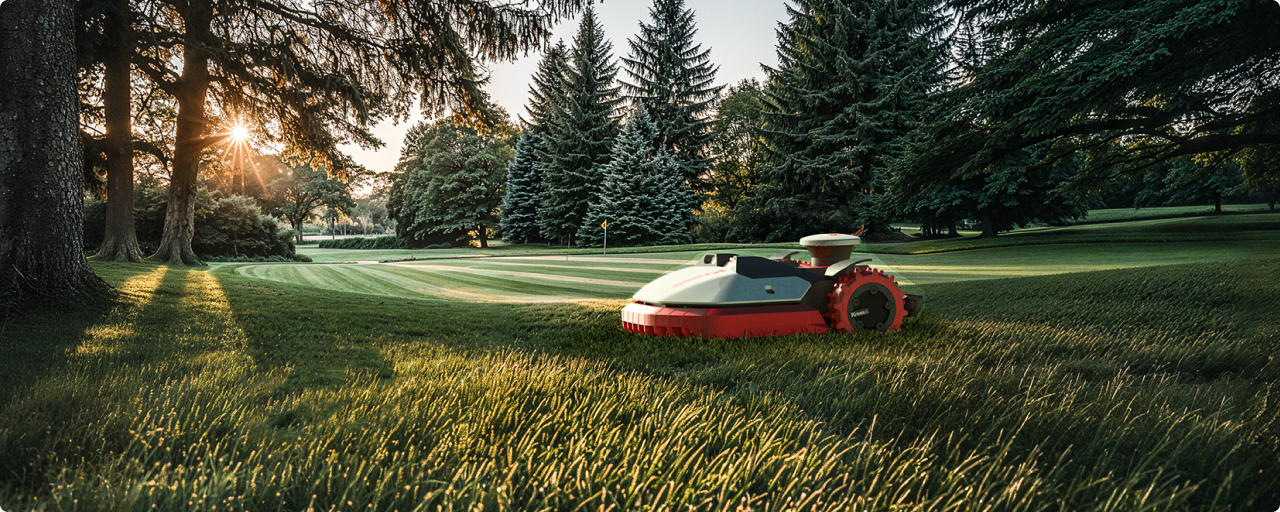
A commercial robotic mower typically costs $6,000 to $15,000 for most multi-acre robotic lawn mower systems, while larger commercial fleet-ready units can reach $60,000 or more before installation, accessories, and ongoing service.
That’s the short answer, at least. The longer answer is that the total commercial robotic lawn mower price depends on the amount of turf you need to maintain, the complexity of the property, the mower’s navigation and obstacle avoidance technology, and how much labor the system can realistically replace or redeploy.
Below is a frank breakdown from the perspective of Green Industries as a dealer.
Commercial Robotic Lawn Mower Price Ranges
Here are the general price ranges most commercial buyers should expect for robot mowers:
| Type of robotic mower | Typical equipment price | Best use cases |
| Large residential/light commercial robotic mower | $3,000 to $6,000 | Large homes, small commercial sites, simple turf areas |
| Multi-acre commercial robotic mower | $6,000 to $15,000 | Campuses, HOAs, sports fields, municipal grounds, golf course areas, commercial properties |
| Fleet-ready or high-output commercial robotic mower | $15,000 to $60,000+ | Contractors, golf courses, municipalities, and large properties scaling robotic mowing across multiple zones |
Most commercial buyers shopping for a serious autonomous mower should plan around $6,000 to $15,000 for the mower itself. Installation, setup, mapping, accessories, and service add further costs.
Kress Robotic Mower Price Examples
Green Industries carries Kress robotic mowing solutions because they’re built for real-world commercial turf care. Kress RTK robotic mowers use satellite-guided navigation instead of traditional buried boundary wire, which makes them a strong fit for larger or more complex properties.
For a better sense of what price you can expect, here are a few examples:
Kress RTKN KR233 Robotic Mower
The Kress KR233 is a strong entry point for commercial robotic mowing. It has a recommended mowing capacity of 3 acres and a maximum capacity of up to 4.5 acres, depending on mowing frequency and site conditions.
Current pricing for the Kress KR233 averages $8,499.99 for the robot mower itself.
This model is a good fit for commercial properties, larger estates, smaller campuses, and turf areas where a crew currently spends several recurring labor hours each week mowing the same ground.
Kress KR236 RTK Robotic Mower
The Kress KR236 steps up to a larger commercial footprint. It has a recommended mowing capacity of 6 acres and a maximum capacity of up to 9 acres.
The current listed price is around $13,799.99.
For properties with several acres of maintained turf, this is where the ROI of a robotic mower begins to shine. The higher purchase price can be easier to justify when the mower is taking over frequent, repetitive mowing that would otherwise require paid crew time every week.
Larger Commercial Robotic Mower Systems
For larger operations, Kress also offers higher-output commercial robotic mowing options, including models designed for greater acreage, fleet coordination, and contractor-style productivity.
These systems can reach $60,000 or more for advanced commercial units such as the Kress KR800 Voyager.
That price point is high, without a doubt. But it starts to make sense when you’re evaluating the robotic mower against a full mowing route, multiple labor positions, high fuel use, or a large commercial site that needs consistent mowing without constantly pulling crew members away from higher-value work.
What Drives Robot Lawn Mower Price?
The price of a robotic mower comes down to acreage, terrain, navigation technology, obstacle handling, and the level of support needed to deploy the system correctly. Here’s a closer look:
1. Acreage Coverage
The more ground a robotic mower can maintain, the more it tends to cost.
A mower designed for a half-acre residential yard isn’t built the same way as a commercial robotic mower expected to maintain several acres across multiple zones. Commercial properties need longer runtime, better traction, stronger cutting systems, smarter scheduling, and more durable components.
When comparing robot lawn mower prices, don’t evaluate models by maximum acreage. Use recommended acreage instead.
Recommended acreage (often known as recommended area) is the more practical number because it reflects how the mower performs under a realistic mowing schedule. Maximum acreage usually assumes longer mowing windows and ideal conditions.
2. RTK Navigation vs Boundary Wire
Older robotic mower systems often depended on buried perimeter wire. That wire adds labor installation time upfront. And it can lead to future repair issues if it gets cut during landscaping, aeration, construction, or utility work.
Kress RTK robotic mowers use satellite-guided RTK navigation. That means they can operate without traditional perimeter wire or a property-specific stationary antenna. For commercial properties, this can reduce installation disruption and make it easier to manage large or changing sites.
RTK technology adds value because it gives the mower the precision needed to mow in professional, organized patterns instead of wandering randomly.
3. OAS (Obstacle Avoidance System)
OAS, or Obstacle Avoidance System, is another factor that affects commercial robotic lawn mower prices.
On a commercial property, the mower encounters trees, signs, benches, curbs, landscaping features, people, animals, maintenance equipment, and temporary objects. Better obstacle detection helps the mower operate more reliably with fewer interruptions.
For many commercial buyers, OAS is a key part of making autonomous mowing practical in a real operating environment.
4. Installation, Mapping, and Setup
Installation is one of the most overlooked parts of the total cost.
Even with wire-free RTK robotic mowers, a commercial robotic mower still needs proper setup. A dealer typically helps with:
- Site evaluation
- Mower selection
- Zone planning
- Mapping
- Docking station placement
- Charging setup
- App configuration
- Schedule setup
- Testing and adjustments
- Operator training
For many commercial robotic mower installations, setup may add $500 to $3,000+. The final cost depends on property size, complexity, number of zones, mower quantity, and how much dealer support you require.
A simple, open property with one large turf area is easier to deploy than a campus with narrow corridors, tree cover, multiple mowing zones, sidewalks, athletic fields, and restricted operating hours. Either way, it’s key to budget for setup before you make a purchase decision.
5. Accessories and Site Requirements
The mower itself is only part of the system. Depending on the property, you may also need:
- Charging station equipment
- Replacement blades
- Extra batteries or power accessories
- Connectivity setup
- Mounting or protection for charging areas
- Additional units for multi-zone properties
- Fleet management support
- Seasonal storage or maintenance service
These items are usually not the biggest part of the budget, but you should still include them when comparing robotic mowing equipment to traditional mowers.
6. Ongoing Service and Maintenance
Robotic mowers reduce many traditional mowing costs, but they aren’t maintenance-free.
Ongoing service may include:
- Blade replacement
- Cleaning
- Software and firmware updates
- Battery health checks
- Wheel and drive system inspection
- Charging station inspection
- Sensor checks
- Seasonal startup and winterization
- Troubleshooting and remapping if the property changes
Compared with gas-powered mowing equipment, robotic mowers eliminate many fuel and engine-related maintenance costs. There are no oil changes, spark plugs, belts, filters, or engine service in the same way a gas mower requires.
However, commercial users should still budget for routine service to keep the system performing properly and get the most value out of it long-term.
How to Think About Robot Mower ROI Versus Traditional Mowing Labor
The real long-term value of a commercial robotic mower is the labor it saves.
Here is a simple way to think about ROI:
Weekly mowing hours saved × hourly labor cost × mowing weeks per year = annual labor value
For example, if a property takes 8 labor hours per week to mow and labor costs $25 per hour, that comes to:
8 hours × $25 × 32 mowing weeks = $6,400 per year
In this example, a mower in the $6,000 to $15,000 range may start to look very different. If the robotic mower can take over most of those repetitive mowing hours, the payback window may be measured in seasons, not decades.
And that calculation doesn’t include fuel savings, reduced wear on traditional equipment, lower noise, more consistent turf appearance, or the ability to move crew members to higher-value work like trimming, edging, pruning, irrigation checks, bed maintenance, enhancements, and customer service.
Robotic Mowers Do Not Replace Every Crew Task
While a commercial mower can offer valuable savings, it’s not a complete landscaping crew in a box.
You may still need people for:
- Trimming
- Edging
- Blowing
- Detail work
- Cleanup
- Steep or highly irregular areas
- Storm debris
- Seasonal turf repairs
- Landscape maintenance outside mowing
The best use case is to let robotic mowers handle the repetitive acreage mowing while your crew takes care of the skilled finish work. With this combination, robotic mowing can improve margins without reducing service quality.
When a Commercial Robotic Mower Makes Financial Sense
A commercial robotic mower is usually worth a serious look when:
- The same turf is being mowed every week
- Labor is hard to hire or retain
- Crews are stretched thin during peak season
- Fuel and maintenance costs keep rising
- Noise reduction matters
- The site has several acres of maintained turf
- Crew time could be better used on higher-value tasks
- The property owner wants cleaner, quieter, lower-emission equipment
It may not be the best fit if the turf area is very small, constantly changing, heavily obstructed, or doesn’t require frequent mowing.
Dealer Support Matters
Buying a commercial robotic mower is different from buying a push mower or even a zero-turn mower:
- The mower needs to be matched to the site.
- The mowing zones need to be planned.
- The system needs to be installed, mapped, tested, and adjusted.
- Someone needs to know how to service the mower when something changes.
These considerations are why working with a dealer matters.
Green Industries helps commercial buyers evaluate property size, mowing frequency, terrain, mower capacity, installation needs, and long-term service expectations before recommending a system.
A review site can estimate a robot lawn mower price, but a dealer can help you understand what the system will actually cost to install, operate, and maintain on your property.
Bottom Line: How Much Does a Robot Lawn Mower Cost?
For commercial use, most robotic mower buyers should expect to spend $6,000 to $15,000 for a capable multi-acre mower, plus $500 to $3,000+ for installation and setup. Larger fleet-ready robotic mowing systems can cost $15,000 to $60,000+, depending on output, acreage, and application.
When evaluating pricing and ROI, ask:
- How many labor hours can it save each week?
- How many acres can it maintain reliably?
- Does it have RTK navigation?
- Does it include obstacle avoidance?
- What installation support is included?
- What ongoing service will it need?
- How quickly can it pay back through labor savings?
For many commercial properties, robotic mowing is a labor strategy instead of just another equipment purchase.
Ready to Price a Commercial Robotic Mower?
Getting excited about robotic mowers? Green Industries can help you compare Kress robotic mower models, estimate installation requirements, and determine whether autonomous mowing makes sense for your property or crew.
Contact Green Industries to schedule a consultation, request pricing, or see which Kress robotic mower is the best fit for your mowing goals.


