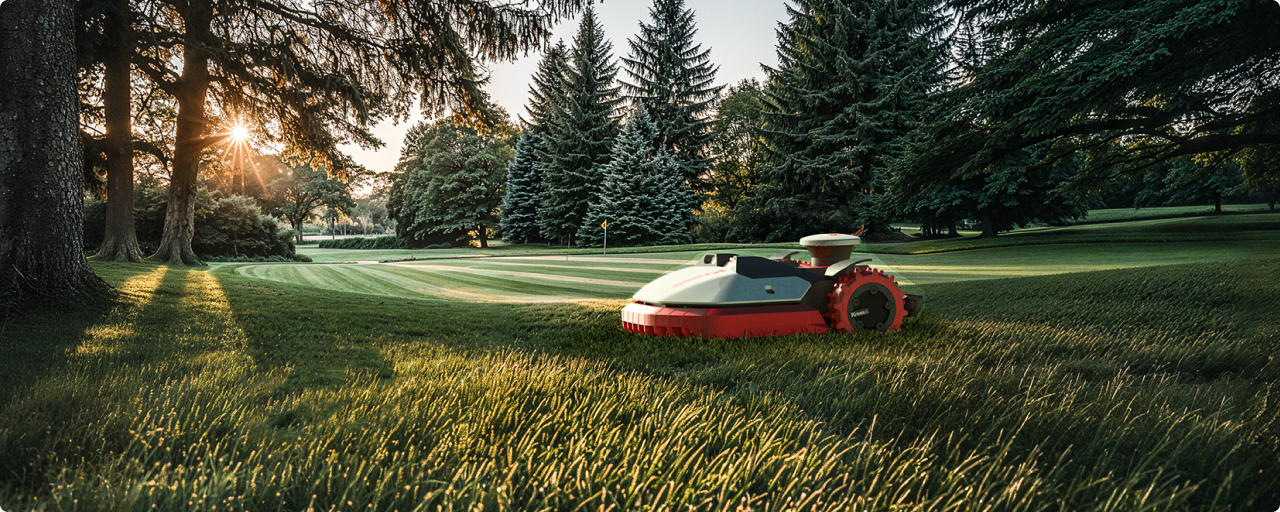


Golf course maintenance demands a level of precision that few other landscapes require. Grounds managers are constantly balancing quality, efficiency, and labor resources.
As staffing challenges continue across the industry, autonomous mowing has emerged as an efficient way to maintain high standards while improving operational flexibility.
A robotic lawn mower for golf courses can help maintain the diverse maintained turf areas in and around your course with consistent cutting schedules and minimal operator involvement. In this blog, we’ll discuss how commercial robotic mowers work, where they fit into golf course maintenance programs, and what grounds managers should consider when evaluating today’s technology before investing in a golf course robot mower.
What Is a Robotic Mower for Sports Fields Like Golf Courses?
A robotic mower for sports fields is an autonomous mower that uses GPS, RTK (Real-Time Kinematic) positioning, or boundary guidance technology to maintain consistent turf height with minimal manual intervention.
On golf courses, robotic mowers are commonly used to maintain roughs, practice areas, driving ranges, and other large turf areas where consistent mowing cut height and frequent mowing improve playing conditions. Modern commercial robotic mowers can operate overnight, navigate complex layouts, and produce high-quality turf while reducing labor demands and fuel consumption.
As golf courses continue to face labor shortages and rising operating costs, robotic mowing has become a practical tool for maintaining healthy turf without sacrificing mowing quality. Rather than replacing grounds crews, robotic mowers allow superintendents to reallocate staff toward specialized agronomic tasks that require hands-on expertise.
Why Golf Courses Are Turning to Electric Power Mowers
Golf course maintenance has always been about consistency. Every mowing pass influences turf density, golf ball roll, aesthetics, and overall playing conditions. Unlike many commercial properties, golf courses operate within narrow maintenance windows while balancing golfer traffic, irrigation schedules, weather, and seasonal turf growth.
Autonomous mowing helps simplify that balancing act.
Because robotic mowers can operate independently for extended periods, they maintain turf on a more frequent schedule than traditional equipment. Instead of removing large amounts of grass once or twice per week, robotic mowers perform continuous light cutting that promotes healthier turf and a cleaner appearance.
For many facilities, this means:
- More consistent playing conditions
- Reduced labor requirements for repetitive mowing
- Lower fuel and maintenance costs
- Quieter operation during early morning or overnight hours
- More time for crews to focus on irrigation, bunker maintenance, and detail work
Where Robotic Mowers Fit in the Golf Industry
While robotic mowers continue to expand their capabilities, they are typically deployed where repetitive mowing delivers the greatest operational value.
Common applications include:
- Primary and secondary roughs
- Driving ranges
- Practice facilities
- Clubhouse grounds
- Perimeter landscaping
- Out-of-play areas
- Walking paths and common spaces
These areas benefit from frequent mowing while allowing maintenance teams to dedicate larger equipment and skilled operators to greens, tees, and fairways where precision equipment and daily adjustments remain essential.
Traits of Autonomous Mowers That Benefit Golf Course Maintenance
Precision Matters: Cutting Height and Turf Quality
One of the biggest concerns for golf superintendents is maintaining the exact height of cut (HOC).
Small variations can affect turf health, aesthetics, and playing performance. Commercial robotic mowers are designed to maintain consistent cutting heights through frequent mowing cycles rather than removing excessive grass during a single pass.
Depending on the application, robotic mowers can be configured for different turf management goals across roughs and other maintained areas. Because mowing occurs more frequently, grass clippings remain small enough to decompose naturally, returning nutrients to the soil and reducing cleanup requirements.
Although robotic mowers are not typically used for greens, where extremely tight HOC tolerances demand specialized equipment, they provide exceptional consistency for many other areas throughout the course.
Overnight Operation Helps Maximize Productivity
One of the greatest advantages of robotic mowing is the ability to work while the course is quiet.
Many golf courses schedule mowing around tee times, tournaments, irrigation cycles, and maintenance activities. Robotic mowers can often operate overnight or during low-traffic periods, allowing turf to be maintained before golfers arrive each morning.
This scheduling flexibility provides several operational benefits:
- Reduced disruption to golfers
- Better utilization of maintenance equipment
- More productive use of maintenance staff
- Improved scheduling flexibility during peak growing seasons
Grounds managers should still account for local conditions such as heavy morning dew, irrigation timing, or weather events when planning autonomous mowing schedules. Proper scheduling helps maintain turf quality while preventing unnecessary stress on the grass.
RTK Technology Improves Precision Without Boundary Wires
Many commercial robotic mowers now use RTK positioning technology instead of traditional mowers’ perimeter wires.
RTK provides highly accurate positioning that allows the mower to navigate complex landscapes while maintaining repeatable mowing patterns. For golf courses, this offers several advantages:
- Digital course mapping
- Easy adjustment of mowing zones
- No buried boundary wire maintenance
- Simple expansion as course layouts change
- Centralized fleet management across multiple mowing areas
These capabilities are especially valuable for golf facilities that routinely modify practice areas, renovate holes, or adjust maintenance plans throughout the season.
Extremely Quiet Operation Supports Traditional Golf Course Experiences
Noise is an often-overlooked advantage of autonomous mowing. Unlike a traditional fairway mower or gas-powered rough mower, commercial robotic mowers are extremely quiet, allowing them to operate with minimal disruption to golfers, nearby neighborhoods, or other maintenance activities.
For traditional golf courses that prioritize the player experience, quiet operation helps preserve the peaceful atmosphere golfers expect while still keeping mowing schedules on track. Whether operating before the first tee time or overnight, robotic mowers can maintain designated turf areas without the engine noise associated with conventional equipment. This flexibility gives grounds managers more opportunities to maintain consistent course conditions while reducing interruptions throughout the day.
What About Slopes and Challenging Terrain: What Can Autonomous Mowing Do
Golf courses rarely consist of flat ground. Commercial robotic mowers are engineered to handle many of the slopes commonly found throughout roughs, practice facilities, and landscaped areas.
Performance depends on the specific model, turf conditions, moisture levels, and slope percentage. When evaluating equipment, grounds managers should consider:
- Maximum slope ratings
- Tire traction
- GPS or RTK signal coverage
- Drainage conditions
- Obstacles such as bunkers, cart paths, and trees
A site evaluation helps determine which areas are best suited for autonomous mowing.
Golf Course Robot Mower Price: What Should You Expect?
One of the most common questions buyers ask is about the golf course robot mower price. The answer depends on several factors, including acreage, number of mowing zones, terrain complexity, RTK infrastructure, fleet size, and software capabilities.
Rather than focusing solely on purchase price, many golf facilities evaluate total cost of ownership by considering:
- Labor savings
- Reduced fuel consumption
- Lower routine maintenance costs
- Improved equipment utilization
- Longer operating hours through autonomous mowing
For courses maintaining multiple rough areas or practice facilities, robotic mowing often delivers value through operational efficiency rather than equipment cost alone.
Green Industries Can Help You Evaluate Robotic Mowing
Choosing the right robotic mower starts with understanding how it fits into your maintenance program.
As a trusted Kress dealer, Green Industries works with golf courses, municipalities, and commercial property managers to evaluate autonomous mowing solutions for their unique properties. Whether you’re exploring robotic mowing for roughs, practice facilities, or other maintained turf areas, our team can help you identify the right equipment and develop a solution that aligns with your operational goals.
Contact Green Industries today to learn more about Kress robotic mowers and discover how autonomous mowing can support a more efficient golf course maintenance program.
Frequently Asked Questions
What is a robotic mower for sports fields?
A robotic mower for sports fields is an autonomous mower that uses advanced positioning technology to maintain consistent turf height without continuous operator involvement. On golf courses, these mowers are commonly used for roughs, practice facilities, driving ranges, and other large turf areas where frequent mowing improves turf quality and operational efficiency.
How noisy are robotic mowers on golf courses?
Commercial robotic mowers operate much more quietly than traditional gas-powered equipment. Their lower noise levels make them well-suited for early morning or overnight operation, helping minimize disruption for golfers and nearby properties.
Can robotic mowers operate overnight?
Yes. Many commercial robotic mowers are designed for overnight operation. Running during off-hours allows courses to maintain turf before golfers arrive while making better use of maintenance schedules and labor resources.
Can robotic mowers handle hills on golf courses?
Many commercial robotic mowers are built to navigate moderate and steep slopes, although maximum performance varies by model and site conditions. Evaluating terrain, moisture levels, and turf conditions helps determine where robotic mowing is most effective.
How precise are robotic mower cutting heights?
Commercial robotic mowers are designed to maintain consistent height-of-cut settings through frequent mowing cycles. While they are not typically used for putting greens, they provide excellent cutting consistency for roughs, practice areas, and many other maintained turf areas across the course.